
Tire Repair: The Honest Truth About What Can (and Cannot) Be Fixed
Rock Molina • February 24, 2026
The Real Difference Between a Safe Repair and a Costly Mistake
Summary
If you’ve ever been told that your tire “can’t be repaired because it’s outside the tread,” you may have felt skeptical. It can sound like a sales tactic. On the other hand, you may have experienced the opposite problem — a puncture that should not have been repaired was patched anyway, only to fail later. The truth about tire repair isn’t based on opinion or profit. It’s based on safety standards established by the U.S. Tire Manufacturers Association. Modern radial tires are engineered in a way that makes certain punctures safely repairable and others unsafe to fix. Understanding where the damage is located — and why that matters — can protect your wallet, your vehicle, and most importantly, your family.
Let’s talk about what’s really going on when a nail ends up in your tire.
It usually happens at the worst time. You walk out of work. The car feels a little funny on the drive home. The next morning you notice a screw or nail in the tire. Your heart sinks a little, but you think, “No big deal — they’ll just patch it.”
Sometimes that’s exactly what happens. Other times you’re told the tire cannot be repaired because the puncture is too close to the sidewall or outside the main tread area. That’s where frustration can set in.
Is it really unsafe? Or is someone just trying to sell a new tire?
The answer comes down to how tires are built.
Modern passenger vehicles use radial tires. These tires are engineered with layers of cords and belts that run at specific angles to give strength, flexibility, and stability. The tread area — the part that contacts the road — is reinforced and designed to handle punctures in a limited, repairable way. But the sidewall is a different story.
The sidewalls of radial tires are built to flex constantly. Every time your tire rotates, the sidewall compresses and rebounds. It absorbs bumps. It carries load. It allows the tread to stay planted on the road. That constant movement is exactly why punctures in the sidewall cannot be safely repaired.
A proper tire repair requires sealing both the inner liner and the injury channel. In the tread area, this can be done because the structure is stable enough to support a patch-and-plug style repair. But in the sidewall, the continuous flexing prevents a repair from holding reliably. Even if it appears to seal at first, the repeated bending can cause the repair to fail. Air can leak. The structure can weaken. In worst cases, the tire can experience a sudden loss of pressure.
This is not a shop preference. It’s an industry safety standard.
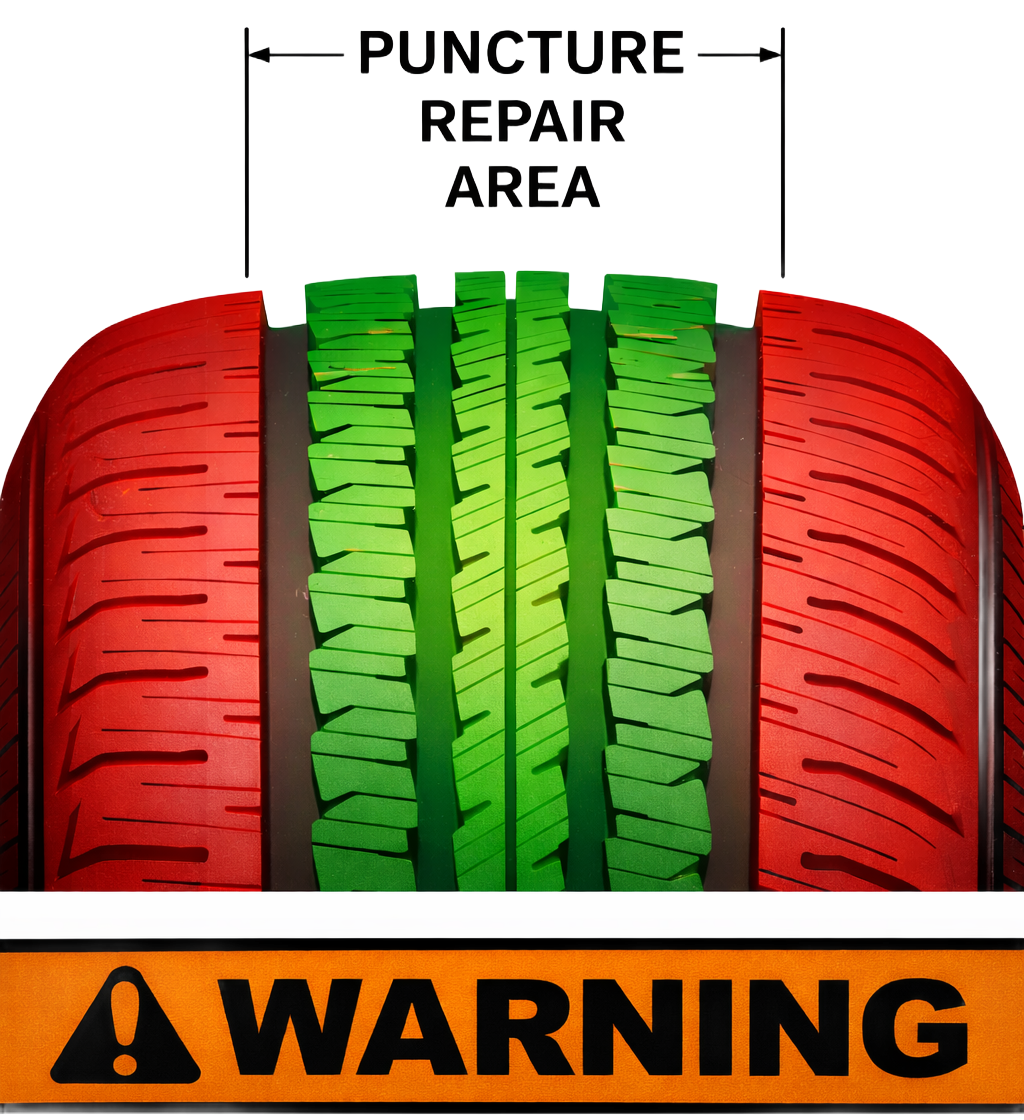
According to the U.S. Tire Manufacturers Association, punctures are only repairable within the crown area of the tread — the central portion that actually contacts the road. Damage in the shoulder area (the outer edges of the tread) or into the sidewall is not considered safe to repair.
Think of it like this: the tread area is the stable backbone of the tire. The sidewall is the flexible joint. You can safely mend a puncture in the backbone. You cannot safely mend one in the joint that bends thousands of times per mile.
Now let’s address the other scenario — when a puncture outside the safe repair zone gets repaired anyway.
This sometimes happens when someone uses a simple external plug inserted from the outside of the tire without removing it from the wheel. These quick fixes can be tempting because they’re inexpensive and fast. The problem is they don’t inspect the inside of the tire for hidden damage, and they don’t account for structural movement in the sidewall.
The result? The repair may hold for a little while. Then it begins to leak. Or worse, the tire weakens internally without obvious warning.
When that happens, customers understandably feel frustrated. “They fixed it last month — why is it flat again?”
The reality is that an improper repair in an unrepairable area often fails because the tire’s design simply doesn’t allow it to succeed long term.
At our shop, we follow established tire industry guidelines not because we want to sell tires, but because we want you driving safely down Highway 190, across the Causeway, or headed out on I-12 without worrying about a blowout. A tire failure at 70 miles per hour is not worth the risk.
So how do you know if your puncture is repairable?
First, location matters most. If the nail or screw is in the center portion of the tread, chances are good it can be properly repaired — assuming the puncture is small and hasn’t caused internal structural damage.
Second, size matters. Large gashes, irregular tears, or damage caused by driving on a severely underinflated tire may make it unsafe to repair even if the puncture is in the tread area.
Third, condition matters. If the tire has very little tread remaining, replacing it may make more sense than repairing it.
When you bring your vehicle to a reputable tire shop, they should remove the tire from the wheel, inspect the interior, and install a proper internal patch-plug combination repair if it qualifies. This method seals the inner liner and fills the injury path, restoring the integrity of the tread area.
If the damage falls outside those parameters, a responsible shop will recommend replacement.
That recommendation can feel inconvenient. But it’s rooted in physics and engineering, not sales strategy.
It’s also important to understand that tire safety isn’t just about the puncture you see. Driving on a tire that has lost significant air pressure — even for a short distance — can damage the internal sidewall cords. From the outside, the tire may look fine. Internally, it may be compromised. That’s another reason proper inspection is critical.
We’ve seen both ends of the spectrum. Customers relieved when a simple tread puncture can be safely repaired. And customers disappointed when the damage is too close to the sidewall to fix.
But we’d much rather have a tough conversation in the shop than see someone stranded on the side of the road later.
Tires are the only part of your vehicle that touch the road. Four small contact patches — about the size of your hand — are responsible for accelerating, braking, turning, and keeping you stable in rainstorms. Compromising that connection to save a tire that cannot safely be repaired just isn’t worth it.
If you ever find yourself staring at a nail in your tire, here’s the best next step: don’t guess. Don’t rely on a gas station plug kit. Bring it to a trusted tire professional who understands industry standards and will inspect it properly.
Sometimes the answer will be good news — it’s repairable. Other times, the safest path forward will be replacement. Either way, you deserve clarity and honesty about why.
The confusion around tire repair often comes from inconsistent practices. But the standards themselves are clear. The sidewall flexes too much to hold a safe repair. Only the central tread area qualifies. Proper repair requires internal inspection and professional installation.
When safety guidelines are followed, you avoid repeat failures, roadside headaches, and unnecessary risk.
At the end of the day, tire repair decisions should be about protecting families, not pushing products. The right call is the one that keeps you confidently rolling down the road.
Frequently Asked Questions
Can all nails in a tire be repaired?
No. Only punctures located in the central tread area may be safely repaired, and only if they meet size and condition guidelines. Punctures near or in the sidewall cannot be safely fixed.
Why can’t sidewall punctures be repaired?
The sidewall of a radial tire flexes constantly while driving. That movement prevents a repair from holding reliably and can lead to failure.
Are plug-only repairs safe?
External plug-only repairs are considered temporary at best. A proper repair involves removing the tire and installing an internal patch-plug combination after inspecting the inside.
How do I know if I drove too long on a flat tire?
If the tire was very low or completely flat and driven on, internal damage may have occurred. A professional inspection is required to determine safety.
Is a repair as good as a new tire?
A proper repair in the correct location can restore safe function for the remaining life of the tire. However, it does not strengthen or renew worn tread.
What should I do if I get a puncture?
Have the tire inspected by a qualified tire professional as soon as possible. Avoid driving long distances on a low tire, and don’t assume every puncture can be safely repaired.
When it comes to tires, the real goal isn’t squeezing every last mile out of rubber. It’s making sure every mile you drive is a safe one.xt, click on it and delete this default text and start typing your own or paste your own from a different source.
check engine light flashing, check engine light diagnosis, check engine light causes, car diagnostics Covington LA, engine diagnostic testing, check engine light repair, auto repair Covington LA
Enhance vehicle safety with expert tire care and wheel alignment services at Rock's Tire & Auto in Covington, LA. Schedule an online appointment today.
Do I have to fix all of this right now?

Cooler Days, Open Roads: Drive and Discover 10 Fall Family “Field Trips” Within a Road Trip of Covington

Light hearted lessons on bad car care advice

What They Mean, What You Should Do & What GM’s 6.2L Recall Means for Owners
Ensure your vehicle's longevity with expert preventative maintenance at Rock's Tire & Auto in Covington, LA. Schedule an online appointment now!
A Code Is a Clue, Not a Diagnosis: Why Proper Testing Matters

The Ultimate Guide to Keeping Your Family Safe on the Road