What Car Repairs Can I Put Off? A Mechanic’s Guide to What’s Urgent, What Can Wait, and What to Budget For
Do I have to fix all of this right now?
What Car Repairs Can I Put Off? A Mechanic’s Guide to What’s Urgent, What Can Wait, and What to Budget For
Quick Summary
You take your vehicle in for an oil change, inspection, or because of one specific concern—and suddenly you're looking at a list of things the technician found.
Brakes. Tires. A leak. A filter. A worn suspension component. Maybe a warning light you've been ignoring for a while.
And the question most people really want answered is:
“Do I have to fix all of this right now?”
Usually, no.
Not every automotive repair or maintenance recommendation carries the same urgency. Some problems can affect your ability to safely steer or stop the vehicle and shouldn't be delayed. Others can turn a relatively manageable repair into a very expensive one if ignored. Some should be planned for in the coming weeks or months. And some maintenance items can reasonably be scheduled for a future visit.
The important thing is knowing the difference.
As a general guide:
Usually urgent: serious brake problems, unsafe tires, steering failures, overheating, oil-pressure warnings, major fluid loss, severe suspension damage, flashing check-engine lights, and certain red dashboard warnings.
Needs attention soon: smaller leaks, weak batteries, worn suspension components that aren't yet unsafe, some check-engine-light concerns, aging belts, and maintenance that's becoming overdue.
Often can be planned: many filters, some routine maintenance, minor comfort concerns, and A/C problems that don't affect vehicle safety or operation.
But there is no universal list that can determine the urgency of every repair without actually inspecting the vehicle. A small leak on one car may be something to monitor; a similar-looking leak on another could be losing enough fluid to cause major damage.
That's why at Rock's Tire & Auto in Covington, we believe the most helpful question isn't simply:
“What's wrong with my car?”
It's:
“What needs to be done now, what can wait, and what should I start budgeting for?”
Our goal is to give you enough information to build a plan—not overwhelm you with a list.
“Do I Really Need to Fix All of This Today?”
It's one of the most common questions in auto repair.
And we completely understand why.
You brought the car in expecting an oil change.
Or maybe you came in because the A/C wasn't cooling.
Then the technician inspected the vehicle and found three other things you weren't expecting.
Now you're looking at an estimate and thinking:
I wasn't planning on spending this much money today.
That's real life.
Most families don't have an unlimited automotive repair budget sitting around waiting for their car to need something. There are mortgages, groceries, school expenses, insurance, vacations, sports, unexpected bills and approximately 4,000 other things competing for the same paycheck.
So when your repair shop finds several concerns, you need more than prices.
You need context.
Is this dangerous?
Could this leave me stranded?
Could waiting damage something else?
Is it routine maintenance?
Can I safely wait until next month?
Could I plan for it three months from now?
If I only have enough money to do one thing today, which thing should I choose?
Those are good questions.
And your repair shop should help you answer them.
At Rock's, we don't believe the client should need to understand every component underneath the vehicle to make a good decision.
That's our job.
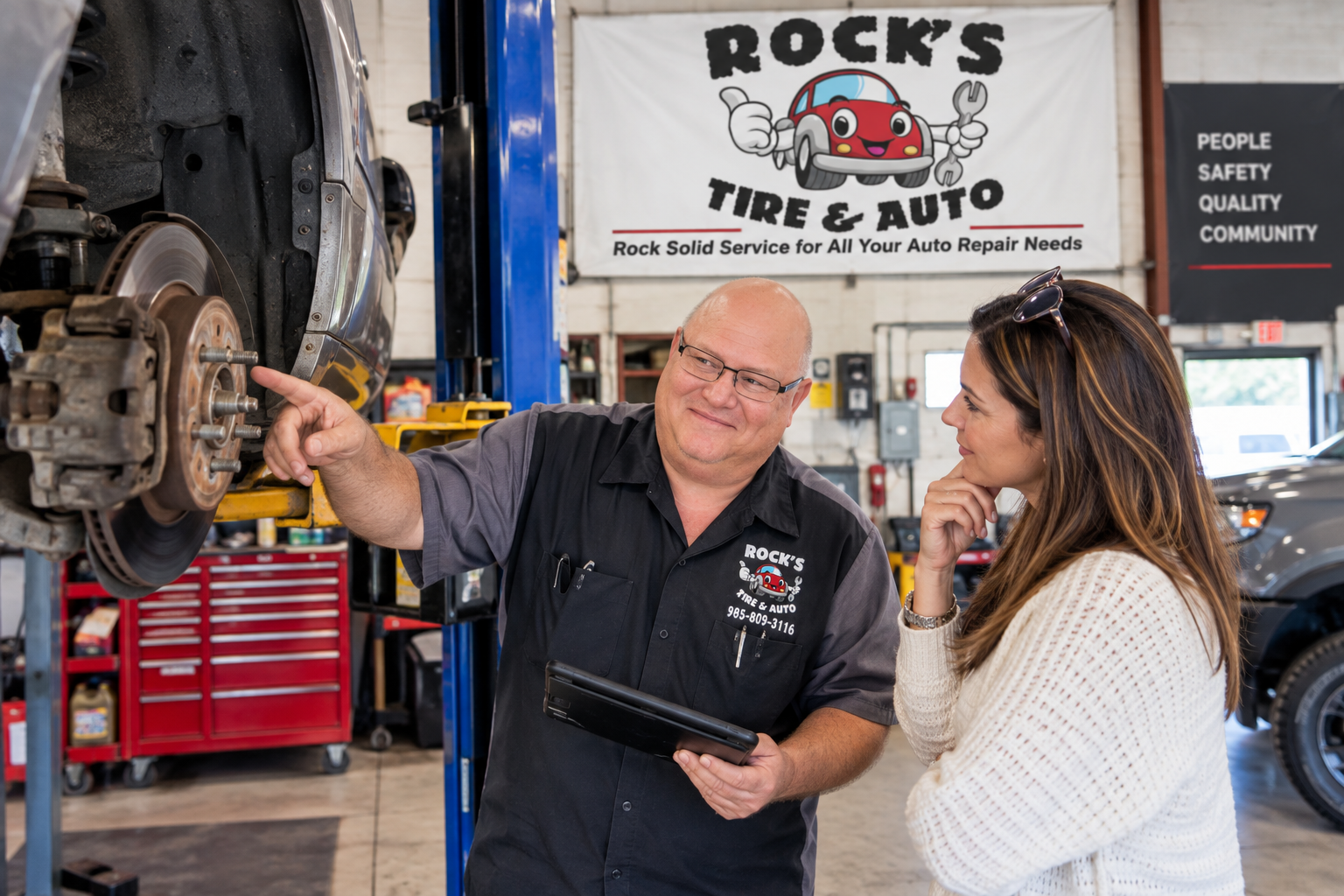
We inspect it. We test when testing is needed. We document what we see. We explain the concern. Then we help you understand how it should be prioritized.
You make the final decision.
That's a much better experience than receiving a giant list of repairs with every item presented as if the car might explode before you make it out of the parking lot.
So let's look at some of the most common things we find and talk about the question everyone wants answered:
Can it wait?
1. Brake Repairs: Sometimes They Can Wait—Sometimes They Absolutely Shouldn't
Can brake repairs wait?
It depends entirely on what is wrong and how severe it is.
“Needs brakes” can describe several very different situations.
A technician might find that your brake pads are beginning to wear and should be planned for later.
That's very different from pads worn completely through the friction material.
And both are different from a hydraulic leak or a brake pedal that suddenly feels abnormal.
That's why simply saying “you need brakes” doesn't give you enough information.
When brakes may be something you can plan for
If your brake pads still have usable material remaining, the braking system is functioning normally, and there aren't other safety concerns, you may be able to plan the repair instead of doing it immediately.
The important thing is knowing approximately where things stand and having them rechecked.
This is exactly where inspections are valuable.
Instead of discovering completely worn brakes when you hear metal grinding, you may learn a few months earlier:
“Your brakes are getting low. They're safe today, but let's plan on them.”
Now you have time.
When brake problems should NOT wait
Brake concerns become much more urgent when you experience things like:
- Grinding or metal-on-metal noises
- A significantly changed brake pedal
- Reduced stopping ability
- Brake-fluid leaks
- A brake warning light
- Severe pulling during braking
- Extremely worn brake components
- Other conditions affecting safe braking
If the vehicle isn't stopping normally, don't assume you can simply drive more carefully until next month.
What happens if I wait too long?
Besides the obvious safety concern, waiting can increase repair costs.
For example, continuing to drive after friction material is worn away can damage components that otherwise might have remained serviceable.
The lesson isn't that every brake recommendation is an emergency.
It's that brakes need to be evaluated based on their actual condition.
Priority: 🔴 Urgent when safety is affected; 🟡 plan ahead when wear is developing.
2. Tires: The Difference Between “Start Budgeting” and “Don't Keep Driving”
Can tires wait?
Again, it depends on why they're being recommended.
Tires don't suddenly go from brand-new to dangerous overnight under normal circumstances.
Tread wears gradually.
That means regular inspections can often give you time to plan.
Maybe the tread is getting low but still serviceable.
That's a budgeting conversation.
But if a tire has structural damage, exposed cords, a significant bulge, or severe wear, that's a very different conversation.
Tire problems that deserve urgent attention
We become much more concerned when we see:
- Exposed cords
- Bulges or “tire eggs”
- Severe cracking or structural damage
- Very low tread
- A tire repeatedly losing air
- Significant impact damage
- Severe uneven wear
- Damage in areas that aren't safely repairable
Remember, your tires are the only things connecting your vehicle to the road.
That becomes particularly important on wet Louisiana roads.
Watch for hidden inside-edge wear
One of the trickiest tire problems is wear you can't easily see.
You look at the outside tread.
Looks fine.
Then the vehicle goes on the lift and the inside edge is nearly worn through.
Alignment issues, worn suspension components, or other problems can create unusual wear patterns.
That's why looking at the whole tire matters.
What happens if I wait?
If the tires are simply approaching replacement depth, waiting a reasonable amount of time while budgeting may be appropriate.
But continuing to drive on unsafe tires increases the risk of tire failure and reduces wet-weather traction.
And if uneven wear has an underlying cause, replacing tires without addressing that cause can ruin the new ones too.
Priority: 🔴 Structural damage/severe wear; 🟡 approaching replacement.
3. Steering Problems: Don't Gamble With Your Ability to Control the Vehicle
Can steering repairs wait?
Some minor steering concerns can be monitored.
Others shouldn't be delayed.
There are numerous components involved in steering the vehicle—tie rods, ball joints, control arms, steering gears or racks, bushings, power-steering components and more.
A little wear isn't automatically the same thing as imminent failure.
The amount and type of wear matter.
When does it become urgent?
Concerns are more urgent when a component has excessive movement, is structurally damaged, or could affect your ability to control the vehicle.
You should also pay attention if the vehicle:
- Suddenly becomes difficult to steer
- Wanders severely
- Has excessive looseness in the steering
- Makes significant clunking noises with steering
- Pulls dramatically
- Has a steering warning light
- Experiences a sudden major change in steering behavior
What happens if I wait?
A worn steering component can contribute to poor handling and tire wear.
If the component deteriorates far enough, the consequences can become much more serious.
This is one category where you want the technician to show you what they're seeing and explain the severity.
“Your tie rod has some wear” and “this component has dangerous movement” aren't the same recommendation.
Priority: 🔴 Excessive wear or control concern; 🟡 minor wear that can be monitored.
4. Suspension Repairs: How Bad Is the Wear?
Suspension is another category where everything shouldn't automatically be labeled an emergency.
Shocks and struts can gradually wear.
Bushings can deteriorate.
Control arms and ball joints can develop play.
Other components can bend, break, or become loose.
Can suspension work wait?
Sometimes.
A slightly worn component that isn't affecting safety may be something you monitor and budget for.
But a badly worn ball joint or structurally compromised component may require much faster action.
Signs that make suspension concerns more important
Pay attention to:
- Severe clunking
- Significant looseness
- Vehicle instability
- Unusual bouncing
- Poor handling
- Rapid or severe tire wear
- Visible broken components
- Vehicle sitting abnormally
- Steering changes
Suspension components don't just determine how comfortable the ride feels.
They help keep the tires properly positioned and in contact with the road.
What happens if I wait?
Depending on the component, you might experience accelerated tire wear, worsening handling, additional stress on related components, or eventually a safety concern.
Priority: 🔴 Broken/severely worn components; 🟡 moderate wear; 🟢 some minor wear can be monitored.
5. Check-Engine Lights: The Light Doesn't Tell You How Urgent the Repair Is
This is where things get interesting.
Can I drive with my check-engine light on?
Maybe.
A steady check-engine light doesn't automatically mean your engine is about to fail.
It means the vehicle's computer has detected a fault.
That could represent many different problems with very different levels of urgency.
Some primarily affect emissions.
Some affect fuel economy.
Some affect drivability.
Some can damage other expensive components if ignored.
That's why the code itself doesn't answer:
“Can this wait?”
The problem needs to be understood first.
When is it more urgent?
A flashing check-engine light deserves immediate attention because it can indicate a severe misfire capable of damaging the catalytic converter.
Likewise, don't keep driving simply because the light is steady if the vehicle is also:
- Shaking badly
- Losing significant power
- Running extremely rough
- Overheating
- Stalling
- Making severe noises
- Showing other warning indicators
A code scan isn't a diagnosis
This is worth repeating.
If someone plugs in a scanner and retrieves a code, that gives us information.
It doesn't necessarily identify the failed part.
A scanner gives us a clue. Testing gives us the answer.
We'd rather determine what's actually causing the problem than have you spend money replacing parts based on guesses.
Priority: 🔴 Flashing light/severe drivability symptoms; 🟡 steady light that needs evaluation.
6. Fluid Leaks: A Few Drops and a Major Leak Are Not the Same Thing
“Your car is leaking.”
Okay.
What is leaking?
How much?
How quickly?
Where is it coming from?
How low is the fluid?
Those details completely change the recommendation.
Can a leak wait?
A very minor seep may sometimes be monitored.
A significant leak from a critical system may make the vehicle unsafe to drive.
Potential automotive leaks include:
- Engine oil
- Coolant
- Brake fluid
- Transmission fluid
- Power-steering fluid on applicable vehicles
- Gear oil
- A/C condensate—which can be completely normal
That last one is important.
Sometimes the puddle under your car is just water draining from the A/C system.
Not every puddle means disaster.
When is a leak urgent?
Be much more cautious if:
- Fluid is pouring out
- A reservoir repeatedly becomes low
- Oil pressure is affected
- The engine is overheating
- Braking or steering is affected
- Transmission operation changes
- You smell burning fluid
- Fluid is contacting hot components
What happens if I wait?
A small oil leak might remain small for a long time—or worsen.
A coolant leak can eventually result in overheating.
A transmission leak can allow fluid levels to become dangerously low.
A brake-fluid leak can affect braking.
The fluid and severity determine the urgency.
Priority: 🔴 Significant loss or safety-critical fluid; 🟡 small active leak; 🟢 minor seep may sometimes be monitored.
7. Cooling-System Problems: Overheating Is One Thing You Shouldn't “See If It Gets Better”
If your temperature gauge starts climbing toward hot, this is not the time for optimism.
Can cooling-system repairs wait?
Minor concerns may sometimes be planned.
An overheating engine should not be ignored.
Your cooling system includes the radiator, thermostat, water pump, hoses, fans, coolant, reservoir, sensors and other components.
A failure anywhere in that system can interfere with the engine's ability to control temperature.
What happens if I keep driving while it's overheating?
You can turn a cooling-system repair into major engine damage.
That's the key point.
Maybe the original problem was relatively manageable.
But severe overheating can damage cylinder heads, head gaskets, internal engine components and more.
Symptoms that make this urgent
- Temperature gauge in the hot zone
- Overheating warning
- Steam
- Rapid coolant loss
- Strong coolant smell
- Coolant pouring from the vehicle
- Repeated overheating
- Heater suddenly blowing cold while the engine temperature climbs
If a vehicle is actively overheating, continuing to drive “just a few more miles” can become a very expensive decision.
Priority: 🔴 Active overheating or major coolant loss; 🟡 small leak or developing issue.
8. Battery Problems: Usually Not Dangerous—but Very Good at Ruining Your Morning
Can a weak battery wait?
Possibly.
But understand the tradeoff.
A battery that tests weak may continue starting the car for weeks.
It may also decide tomorrow morning is the morning it's finished.
That's why a weak battery is often less about immediate safety and more about reliability and inconvenience.
Louisiana heat is tough on batteries
People often associate dead batteries with winter.
But heat is extremely hard on battery life.
After surviving our summer temperatures, an aging battery may reveal its weakness as conditions change.
Signs to pay attention to
- Slow cranking
- Clicking when starting
- Repeated need for a jump
- Battery warning indicator
- Electrical concerns
- Corrosion or damaged terminals
- Battery testing poorly
And remember: a dead battery doesn't automatically mean the battery itself caused the problem.
The charging system, electrical connections, parasitic draws and other concerns can also be involved.
Priority: 🟡 Weak battery—plan soon; 🔴 charging-system warning or repeated no-start needs diagnosis.
9. A/C Repairs: Usually Comfort—But Not Always
Here in Louisiana, calling air conditioning a “comfort feature” feels slightly insulting.
In August, functioning A/C feels pretty close to a constitutional right.
Still, from a mechanical safety standpoint, many A/C failures don't prevent a vehicle from being driven.
Can A/C repair wait?
Often, yes.
If the only problem is that the cabin isn't cooling properly and the failure isn't affecting other vehicle systems, you can often schedule the repair around your budget.
Whether you want to wait through a Louisiana summer is another conversation entirely.
When might A/C become more important?
Some HVAC problems can affect windshield defogging or involve components that are creating noise, belt problems, electrical concerns, or other secondary issues.
Those deserve more attention.
Don't just keep adding refrigerant
If an A/C system is low on refrigerant, there's a reason.
Refrigerant doesn't normally get consumed like fuel.
Adding more without identifying why it's low can mask the problem rather than solve it.
Priority: 🟢 Often budget/comfort; 🟡 if related problems or defogging are affected.
10. Belts: “Looks a Little Old” and “About to Leave You Stranded” Are Different
Modern vehicles commonly use a serpentine belt to drive important accessories.
Depending on the vehicle, that can include the alternator, A/C compressor, power-steering pump, water pump or other components.
Can belt replacement wait?
A belt showing normal age but no significant damage may simply need to be planned for.
A belt with severe deterioration, missing material, contamination, or other significant problems deserves faster attention.
Timing belts are a separate category entirely.
Timing belts deserve special attention
On vehicles equipped with timing belts, manufacturers generally specify replacement intervals.
Ignoring that interval can be a serious gamble, particularly on engines where timing-belt failure can cause internal engine damage.
That's preventive maintenance where the entire point is to replace the component before it fails.
Priority: 🟡 Aging serpentine belt; 🔴 severely damaged belt; manufacturer-specified priority for timing belts.
11. Filters: Usually Something You Can Plan
Finally, an easy one.
Does a dirty air filter need to be replaced immediately?
Usually not.
Engine and cabin air filters are maintenance items.
If they're moderately dirty, they can typically be planned for.
If they're severely restricted, contaminated, wet, damaged, or full of debris, replacement becomes more worthwhile.
Engine air filter
The engine air filter helps prevent dirt and debris from entering the engine.
Cabin air filter
The cabin filter helps clean air entering the passenger compartment through the HVAC system.
A dirty cabin filter isn't normally in the same urgency category as unsafe brakes.
And it shouldn't be presented that way.
Priority: 🟢 Usually routine maintenance.
12. Maintenance That's Overdue: How Overdue Are We Talking?
“Your maintenance is due” isn't necessarily the same thing as:
“Your car is unsafe.”
Maintenance is designed to reduce wear, protect systems and prevent future problems.
That includes things such as:
- Oil service
- Brake-fluid service
- Coolant service
- Spark plugs
- Transmission service when appropriate
- Differential or transfer-case fluids
- Filters
- Timing-belt replacement on applicable vehicles
- Other manufacturer-specified services
Can maintenance wait?
Sometimes a little.
But continually saying “next time” can eventually catch up with you.
There's a big difference between being 500 miles past an oil-change interval and repeatedly stretching oil changes thousands of miles beyond what's appropriate.
Likewise, some scheduled maintenance—such as timing-belt replacement—can carry much greater consequences if neglected.
Priority: 🟢 Slightly due routine maintenance; 🟡 increasingly overdue; potentially 🔴 depending on the component and consequences of failure.
13. Strange Noises: Your Car's Version of “We Need to Talk”
A strange noise is a symptom.
It isn't a diagnosis.
And urgency depends entirely on what's making it.
Can I wait and see if the noise goes away?
Sometimes noises are harmless.
Sometimes they're the first warning of a serious problem.
The difficult part is that the average driver shouldn't be expected to know which is which.
A squeak could be minor.
A grinding noise could be brakes.
A humming noise could be a wheel bearing.
A clunk could be suspension.
A ticking or knocking sound could involve the engine.
A rattling heat shield is very different from internal engine knock.
When should you take a noise seriously?
If the noise is:
- Suddenly loud
- Getting rapidly worse
- Accompanied by vibration
- Related to braking
- Related to steering
- Coming with warning lights
- Associated with overheating
- Accompanied by loss of power
- A grinding, knocking or heavy clunk
…don't just turn the radio up.
Although we admit that's a very popular diagnostic procedure.
Priority: ❓ Unknown until evaluated. New or severe noises deserve attention.
14. Dashboard Warning Lights: Red Usually Deserves More Respect
Modern dashboards can look like Christmas trees when something goes wrong.
Not every light has the same meaning.
Generally speaking
A red warning often indicates something requiring immediate attention.
A yellow or amber warning usually means a system needs attention but may not require you to stop instantly.
However, there are exceptions, and the vehicle's owner's manual is the best reference for the specific warning.
Warning lights you should take seriously
Particular attention should be given to warnings involving:
- Oil pressure
- Engine temperature
- Braking system
- Charging system
- Steering
- Flashing check-engine light
If you're unsure what a warning means, don't guess.
Call and ask.
Priority: 🔴 Many red warnings; 🟡 many amber warnings—but always identify the actual warning.
So How Does Rock's Decide What Comes First?
This is where automotive repair becomes less about a list and more about a plan.
At Rock's Tire & Auto, our Vehicle Wellness Check and Digital Vehicle Inspection help us look at the overall condition of the vehicle.
When appropriate, we use photos and videos so you can see what we're seeing.
But finding something doesn't automatically mean:
“You must fix this today.”
The inspection gives us information.
Then we prioritize that information.
We generally think about recommendations through several questions.
Is it a safety concern?
Can it affect your ability to stop, steer, control the vehicle, or safely remain on the road?
That moves it toward the top.
Could it cause major additional damage?
A cooling-system problem that could lead to overheating may need attention sooner than a cabin filter because the consequences of waiting are very different.
Could it leave you stranded?
A weak battery may not be a safety emergency, but if you're driving your kids to school every morning and can't afford an unexpected no-start, it may be high on your priority list.
Is it maintenance?
Maintenance can often be scheduled and budgeted rather than treated as an emergency.
What are your plans for the vehicle?
This matters more than people realize.
Are you keeping it for another ten years?
Giving it to your teenager?
Trading it in six months?
Driving 30,000 miles a year?
Using it only on weekends?
Heading on a 2,000-mile road trip next month?
The right plan can be different for each of those situations.
A Red, Yellow and Green Approach to Auto Repair
An easy way to think about repair recommendations is like a traffic light.
🔴 RED: Address Now
These are concerns involving immediate safety, risk of significant damage, or conditions where continuing to operate the vehicle may not be advisable.
Examples might include severely compromised tires, significant braking concerns, overheating, oil-pressure loss, certain steering problems, major fluid leaks, or other critical failures.
🟡 YELLOW: Plan for It
These concerns may not require repair today, but they're developing and shouldn't be forgotten.
This could include worn components that are still serviceable, a weak battery, a small leak, maintenance that's becoming due, or tires approaching replacement.
Yellow means:
Let's make a plan.
Not:
Ignore it forever.
🟢 GREEN: Good or Monitor
Some components are in good condition.
Others may show minor wear that simply needs to be rechecked later.
And sometimes the best thing we can tell you is:
“That's fine. You don't need it.”
We like giving that answer too.
What If I Can't Afford Everything My Car Needs?
Tell us.
Really.
There's no embarrassment in having a budget.
We all have one.
If your vehicle has $2,500 worth of recommendations and you have $600 available, the useful question becomes:
“Where will that $600 make the biggest difference?”
Maybe it's the tires.
Maybe it's the brakes.
Maybe there's one repair that prevents a much more expensive failure.
Maybe everything is safe enough that we can divide the work over the next several months.
The answer depends on the vehicle.
But we can't help you build a realistic plan if we pretend money doesn't matter.
A good repair plan should consider:
Safety + reliability + your plans + your budget.
That's how real people own cars.
The Goal Isn't to Sell You Everything. It's to Help You Understand Everything.
One of the reasons auto repair can feel stressful is the knowledge gap.
Your technician may spend years learning how these systems operate.
You're hearing about the problem for the first time while standing at work, picking up kids, or trying to figure out whether you can still make your 3:00 appointment.
That's not exactly an ideal environment for becoming an expert on ball joints.
You shouldn't have to.
Our job at Rock's is to take the technical information and make it useful to you.
Here's what we found.
Here's a picture or video when appropriate.
Here's why it matters.
Here's what could happen if you wait.
Here's how we'd prioritize it.
Then you decide.
That's the relationship we want with our clients.
We're not here just to fix today's broken part.
We want to help you understand your vehicle well enough to make confident decisions about it over time.
Don't Wait for Your Car to Make the Decision for You
There is a huge difference between:
“Your battery is getting weak. Let's plan to replace it.”
and
click-click-click at 7:15 Monday morning.
There's a difference between:
“Your tires are getting low. Let's budget for them before rainy season.”
and discovering cords showing when you're supposed to leave for vacation tomorrow.
There's a difference between:
“We're seeing a small coolant leak.”
and sitting on the shoulder with steam coming from under the hood.
Preventive inspections can't predict every failure.
Cars are machines. Things can break unexpectedly.
But knowing what's developing gives you something extremely valuable:
Choices.
You can choose when to repair it.
You can budget for it.
You can schedule around work.
You can decide whether the vehicle is worth continuing to invest in.
You can plan around a trip.
You can get a second opinion.
You can ask questions.
Once the vehicle breaks down, many of those choices disappear.
Now the car is making the schedule.
And cars are notoriously inconsiderate about scheduling.
The Most Important Question to Ask Your Mechanic
The next time you're handed several repair recommendations, don't simply ask:
“How much is all of it?”
Ask:
“If this were your vehicle, what would you do first?”
Then follow it with:
“What can safely wait?”
And:
“What happens if I wait?”
Those three questions can completely change the conversation.
A trustworthy repair shop should be willing to help you understand the answers.
Because good auto repair isn't about creating urgency where it doesn't exist.
And it isn't about ignoring problems until they become emergencies.
It's about knowing the difference.
Frequently Asked Questions: What Car Repairs Can Wait?
What car repairs should I never put off?
Problems affecting safe braking, steering, tire integrity, engine oil pressure, or severe overheating generally deserve immediate attention. Significant fluid loss, certain red warning lights, severe suspension failures, and a flashing check-engine light can also indicate urgent conditions. The exact urgency depends on the vehicle and diagnosis.
What car repairs can usually wait?
Some routine maintenance, moderately dirty filters, minor cosmetic problems, many A/C concerns, and components showing early stages of wear may often be scheduled rather than repaired immediately. However, an inspection is necessary to determine whether a particular condition is actually safe to postpone.
Do I need to fix everything my mechanic recommends at once?
Usually not. A good inspection may identify immediate concerns, upcoming maintenance, developing wear and items that simply need monitoring. Ask the shop to prioritize recommendations by safety, reliability and urgency.
How do I know if a mechanic is creating unnecessary urgency?
Ask the shop to show you the concern and explain why it needs immediate attention. Ask what could happen if you wait and whether the recommendation is related to safety, reliability, maintenance or prevention. A good shop should be comfortable answering those questions.
Can worn brakes wait a month?
It depends on how much friction material remains and whether the rest of the braking system is functioning correctly. Brakes with usable life remaining may sometimes be planned for. Grinding brakes, hydraulic leaks, severely worn components, reduced stopping ability or other significant concerns should not be delayed.
Can I drive on tires with low tread?
Tires approaching replacement may sometimes give you time to budget, but severely worn tires have reduced wet-weather traction and may become unsafe. Exposed cords, bulges, structural damage or severe uneven wear require prompt attention.
Can I drive with a check-engine light?
A steady check-engine light may allow continued driving depending on the fault and how the vehicle is operating, but it should be evaluated. A flashing check-engine light can indicate a severe misfire and deserves immediate attention. If the vehicle is shaking, overheating, stalling or losing significant power, seek advice before continuing.
Is an oil leak urgent?
It depends on the amount and source. A small seep may sometimes be monitored. A significant leak that causes the oil level or pressure to drop can result in severe engine damage. Have the source and severity determined before deciding whether it can wait.
Is a coolant leak urgent?
A minor coolant leak may provide some time for repair, but coolant loss can eventually cause overheating. If the vehicle is overheating, losing coolant rapidly or showing a temperature warning, stop driving and have the problem evaluated.
Can I drive my car while it's overheating?
Continuing to drive an overheating engine can cause severe and expensive engine damage. If your vehicle is actively overheating, safely stop driving and get assistance rather than trying to make it “just a few more miles.”
How urgent is a weak battery?
A weak battery is often a reliability concern rather than an immediate safety issue, but it can leave you stranded without much warning. If testing shows the battery is near the end of its useful life, planning replacement can help avoid an inconvenient no-start.
Can I put off suspension repairs?
Some minor suspension wear can be monitored. Severe looseness, broken components, major handling changes, significant tire wear, or components that could affect vehicle control should be addressed promptly.
Is a wheel alignment urgent?
It depends on why the alignment is needed. A slightly off alignment may primarily cause gradual tire wear. Severe alignment problems can affect handling and destroy tires quickly. If the vehicle suddenly pulls after an impact or suspension damage, have it inspected.
Can I wait to replace my cabin air filter?
Usually, yes. A cabin air filter is generally a routine maintenance item rather than an immediate safety repair. A severely restricted filter can reduce HVAC airflow and should be replaced, but it typically isn't in the same urgency category as brakes or tires.
Can I delay an A/C repair?
If the A/C problem only affects cabin comfort, you can often schedule it according to your budget—although Louisiana summer may have other opinions. Problems affecting windshield defogging or involving other mechanical or electrical concerns may deserve faster attention.
What does a red recommendation on a Digital Vehicle Inspection mean?
At Rock's, the purpose of prioritization is to help clients distinguish higher-priority concerns from items that can be planned or monitored. The technician or service advisor should explain the specific reason an item is considered important rather than expecting the color alone to make the decision for you.
What is a Vehicle Wellness Check?
A Vehicle Wellness Check gives us an opportunity to look over the vehicle and identify visible concerns, maintenance needs and developing wear. It isn't automatically a diagnosis of every possible problem. If a specific symptom or problem requires testing to determine the root cause, additional diagnostic evaluation may be necessary.
Should I repair an older car or replace it?
That decision depends on much more than the cost of today's repair. Consider the vehicle's overall condition, reliability, mileage, maintenance history, upcoming needs, how long you want to keep it, and what replacing it would cost. Sometimes investing in a well-maintained older vehicle makes sense; other times the overall repair picture may suggest it's time to move on.
What should I ask when I can't afford every recommended repair?
Ask:
“What affects my safety?”
“What is most likely to leave me stranded?”
“What could become much more expensive if I wait?”
“What can I safely plan for later?”
Those answers can help you spend the money you have available where it matters most.
How does Rock's Tire & Auto help clients prioritize repairs?
We use inspections, testing when needed, Digital Vehicle Inspections with photos and videos, and clear communication to help clients understand the condition of their vehicles. Instead of treating every recommendation as equally urgent, we want you to understand what needs attention, why it matters and how it fits into a longer-term plan.
Where can I get a vehicle inspection or repair plan in Covington, Louisiana?
If you're in Covington or the surrounding St. Tammany Parish area, Rock's Tire & Auto can inspect your vehicle, explain what we find and help you prioritize repairs and maintenance based on safety, reliability, your plans for the vehicle and your budget.
You don't have to walk in knowing what's wrong.
You don't have to know the difference between a ball joint and a tie rod.
And you don't have to say yes to everything at once.
Bring us the car. Tell us what's important to you. We'll help you make a plan.
📍
Rock's Tire & Auto | Covington, Louisiana
📞
985-809-3116
💻
RocksTireAuto.net
Car trouble is stressful. Figuring out what to fix first shouldn't be.