Check Engine Light On? Don’t Panic!
Here’s What Your Car Is Trying to Tell You
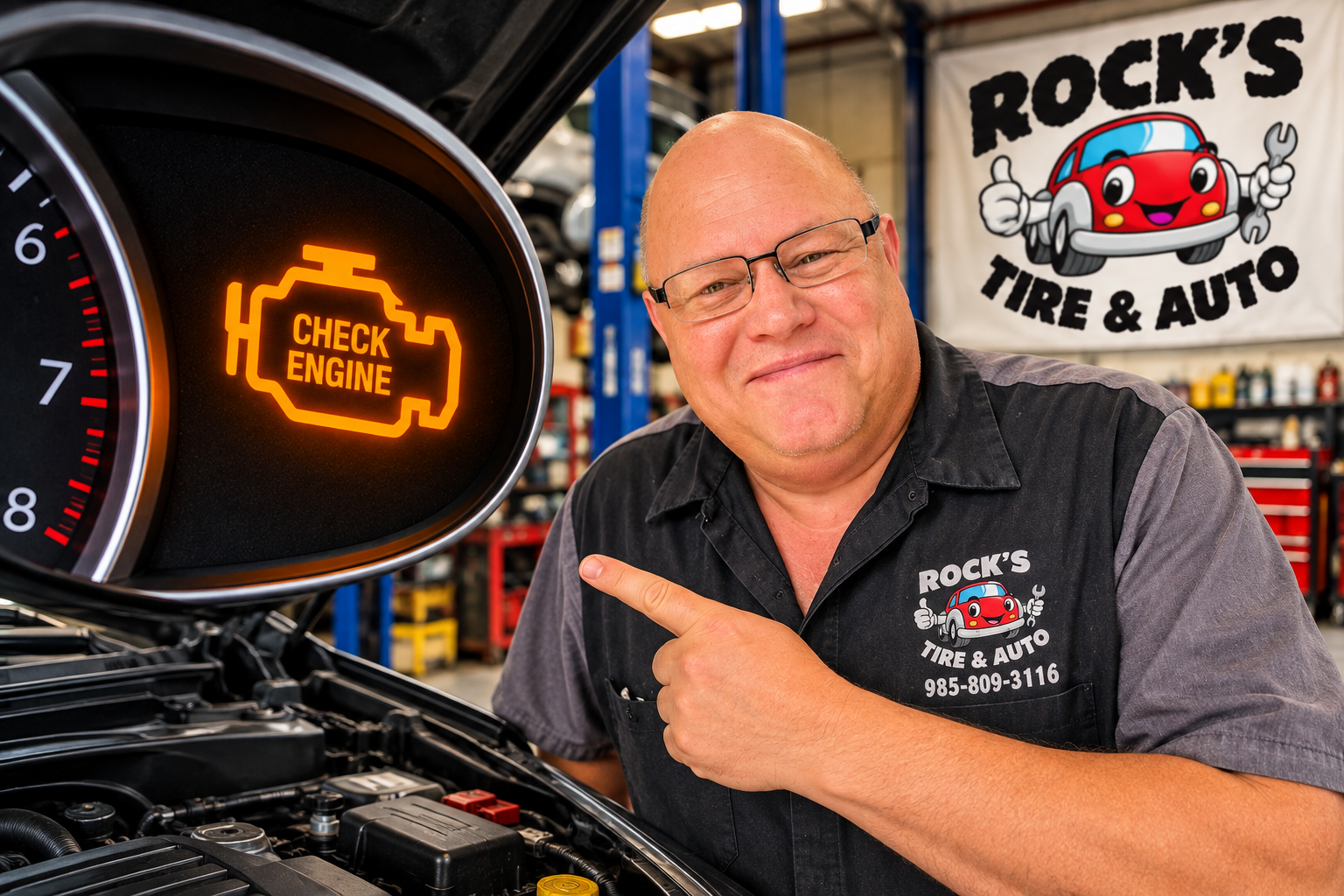
There it is.
You start your car, glance at the dashboard, and suddenly notice that little orange engine-shaped light staring back at you.
The check engine light.
Immediately, your brain starts filling in the blanks.
Is my engine about to die? How much is this going to cost? Can I still drive to work? Is it just the gas cap? Didn't I just have this car serviced? Maybe if I turn the car off and restart it, it'll disappear...
And our personal favorite:
Maybe if I ignore it long enough, the bulb will burn out.
Technically, that would make the light go away.
It would not, however, fix your car.
At Rock’s Tire & Auto in Covington, Louisiana, we understand that a check engine light can be stressful because it tells you almost nothing by itself. It doesn't say:
"Hey, your purge valve isn't working correctly. It's not an emergency, but let's get that taken care of."
It just turns on a mysterious orange light and lets your imagination handle the rest.
The good news is that a check engine light does not automatically mean your engine is ruined or that you're facing a huge repair bill.
But it does mean your vehicle's computer has detected something outside its expected operating parameters, and the smartest thing you can do is find out why.
Let's take some of the mystery—and hopefully some of the anxiety—out of that little orange light.
What Does the Check Engine Light Actually Mean?
Modern vehicles have multiple computers constantly monitoring systems throughout the vehicle.
One of the most important is the engine control module, often called the ECM or PCM depending on the vehicle.
It monitors information from sensors and systems involving things such as:
- Engine performance
- Fuel delivery
- Ignition
- Airflow
- Emissions
- Exhaust
- Transmission operation
- Engine temperature
- Evaporative emissions
When the computer sees something operating outside its expected range, it may store a diagnostic trouble code, commonly called a DTC.
Depending on the problem, it may also illuminate the check engine light.
Think of the check engine light as your car saying:
"Something isn't right. Somebody needs to check this out."
Notice what it isn't saying:
"Replace the oxygen sensor."
That's an important distinction.
A Trouble Code Is Not a Diagnosis
This is probably one of the biggest misunderstandings we see in auto repair.
Someone plugs a scanner into the vehicle and gets a code such as:
P0302 – Cylinder 2 Misfire Detected
Then comes the conclusion:
"Great! It needs a spark plug."
Maybe.
It could also be a failing ignition coil, fuel injector problem, wiring issue, vacuum leak, compression problem, mechanical engine issue or something else.
The code identifies what the computer noticed.
It doesn't necessarily identify what caused it.
Here's another example.
Suppose your vehicle has a code indicating that an oxygen sensor is reporting a lean condition.
That doesn't automatically mean the oxygen sensor is bad.
The sensor may be doing its job perfectly and reporting a problem caused by unmetered air entering the engine, low fuel pressure, an intake leak or another issue.
Replacing the sensor without testing could leave you with:
a brand-new oxygen sensor...and the exact same check engine light.
That's why at Rock's, we don't believe in guessing.
A scan tool gives a technician clues.
Testing confirms the answer.
That distinction can save you from replacing perfectly good parts—and paying for repairs that don't solve your problem.
First Question: Is the Check Engine Light Solid or Flashing?
This is the first thing we want you to notice.
Because these two situations can mean very different things.
A Solid Check Engine Light
If your check engine light comes on and stays illuminated, the vehicle's computer has detected a fault.
If the car seems to be running normally, a solid light generally doesn't mean you need to immediately pull over and call a tow truck.
But don't ignore it.
Schedule an appointment to have the vehicle checked.
The problem could be relatively minor today but become more expensive if left unresolved.
You should also pay attention to anything else the vehicle is doing.
Is it:
- Shaking?
- Losing power?
- Running rough?
- Hard to start?
- Stalling?
- Smelling unusual?
- Overheating?
- Making a new noise?
- Getting dramatically worse fuel mileage?
If the check engine light is accompanied by significant symptoms, treat the situation more seriously.
What If the Check Engine Light Is Flashing?
A flashing check engine light deserves immediate attention.
On many vehicles, a flashing check engine light indicates a severe engine misfire that can potentially damage the catalytic converter.
When an engine misfires, fuel may enter the exhaust system without being properly burned inside the cylinder.
That unburned fuel can reach the catalytic converter and cause it to become extremely hot.
And catalytic converters aren't exactly known for being inexpensive.
If your check engine light begins flashing—especially if the vehicle is shaking, running badly or losing power—reduce your speed, avoid hard acceleration and get somewhere safe.
Continuing to drive can turn one repair into several.
When you're unsure whether it's safe to continue driving, call your repair shop and describe exactly what's happening.
Sometimes the least expensive decision you can make is paying for a tow.
Can I Drive With My Check Engine Light On?
The answer is:
It depends.
We know. Everybody loves that answer.
If the light is solid and the vehicle is running normally, you can often drive it carefully long enough to get it inspected.
But if you notice any of the following, you should reconsider continuing to drive:
- Flashing check engine light
- Severe shaking
- Major loss of power
- Overheating
- Oil-pressure warning
- Loud knocking
- Strong fuel smell
- Smoke
- Stalling
- Difficulty keeping the engine running
A check engine light combined with another warning light or major symptom changes the situation.
When in doubt, protecting the engine and catalytic converter is much cheaper than hoping for the best.
First Thing to Check: Your Gas Cap
Yes, sometimes it really can be that simple.
Your fuel system is designed to contain fuel vapors rather than allowing them to escape into the atmosphere. The evaporative emissions system—usually called the EVAP system—monitors this process.
A loose, damaged or improperly sealing gas cap can sometimes trigger an EVAP-related trouble code and illuminate the check engine light.
If your light appeared shortly after getting gas:
- Make sure the gas cap is installed correctly.
- Look for obvious damage to the cap or seal.
- Tighten it according to the manufacturer's design.
But here's something many people don't realize:
The check engine light may not immediately turn off after you tighten the cap.
The computer may need to run its EVAP self-test again, which can require several drive cycles and specific conditions.
And if the light remains on, don't keep buying gas caps.
There are numerous other components in the EVAP system that can cause similar codes.
Common Reasons Your Check Engine Light Comes On
There are hundreds—sometimes thousands—of possible diagnostic trouble codes depending on the vehicle.
So this isn't an exhaustive list.
But these are some common areas technicians investigate.
1. Loose or Faulty Gas Cap
Let's start with the inexpensive possibility.
A damaged or loose gas cap can allow fuel vapors to escape and trigger an EVAP code.
Possible repair: Tighten or replace the cap if testing confirms it's the problem.
Cost compared with other possibilities?
Let's just say this is the one everybody hopes for.
2. EVAP System Leak
If it isn't the gas cap, the evaporative emissions system contains hoses, valves, sensors and other components that can leak or malfunction.
Very small EVAP leaks can be especially tricky.
Sometimes technicians use a smoke machine to introduce safe diagnostic smoke into the system and locate a leak that would be almost impossible to see otherwise.
Possible repairs: Repair a leaking hose or connection, replace a failed purge or vent valve, repair wiring, or replace another failed EVAP component based on testing.
3. Faulty Oxygen Sensor
Oxygen sensors monitor the oxygen content in the exhaust and provide information the computer uses to manage engine operation and monitor catalytic-converter performance.
They live in a very hot, harsh environment and can eventually fail.
But remember our earlier rule:
An oxygen-sensor code doesn't automatically mean "replace the oxygen sensor."
The technician needs to determine whether the sensor itself is failing or whether it's accurately reporting another problem.
Possible repair: Oxygen sensor replacement—if testing confirms it.
4. Engine Misfire
A misfire means one or more cylinders aren't contributing properly.
You may notice:
- Shaking
- Rough idle
- Hesitation
- Reduced power
- Flashing check engine light
Possible causes include ignition, fuel, electrical and mechanical problems.
Possible repairs: Spark plugs, ignition coils, injectors, wiring repairs, vacuum-leak repairs or mechanical engine repairs, depending on the actual cause.
This is exactly why "It has a misfire code" isn't enough information to start throwing parts at it.
5. Worn Spark Plugs
Spark plugs ignite the air-fuel mixture inside gasoline engines.
As they wear, the spark may become less effective, potentially contributing to misfires, poor performance and reduced fuel economy.
Spark plugs are also maintenance items on many vehicles and should be replaced at the manufacturer's recommended interval.
Possible repair: Replace the spark plugs and inspect related ignition components when appropriate.
6. Failing Ignition Coil
Ignition coils generate the high voltage needed for the spark plugs.
A failing coil can cause a cylinder to misfire.
But before replacing one, the technician should confirm that the coil is actually responsible.
Possible repair: Replace the failed coil and address any related problems found during testing.
7. Mass Airflow Sensor Problems
The mass airflow sensor helps the vehicle's computer determine how much air is entering the engine.
Incorrect airflow information can affect fuel delivery and engine performance.
Sometimes the sensor is contaminated. Sometimes it fails. Sometimes the real problem is elsewhere.
Possible repair: Cleaning, repairing wiring or replacing the sensor when appropriate.
8. Vacuum or Intake Leak
Engines depend on controlled airflow.
A cracked hose, leaking intake gasket or other vacuum leak can allow air into the engine that the computer wasn't expecting.
That can affect fuel mixture and trigger lean-condition codes, misfires or other problems.
Possible repair: Locate and repair the source of the air leak.
Smoke testing can sometimes help here too.
9. Fuel Injector Problem
Fuel injectors deliver fuel to the engine.
A clogged, electrically failed or mechanically malfunctioning injector can contribute to:
- Misfires
- Rough running
- Starting problems
- Poor performance
- Check engine light illumination
Possible repair: Injector service or replacement when testing supports it.
10. Fuel Delivery Problems
Low fuel pressure or insufficient fuel delivery can create drivability problems and diagnostic codes.
Potential causes include the fuel pump, electrical circuits, pressure-control components or other parts of the fuel system.
Possible repair: Depends entirely on testing.
Notice a theme developing?
We don't want to replace the expensive thing until we know the expensive thing is actually broken.
11. Catalytic Converter Problems
The catalytic converter helps reduce harmful exhaust emissions.
A failing or inefficient catalytic converter can trigger a check engine light.
But there's an important question:
Why did the catalytic converter fail?
Sometimes converter failure is the end result of another unresolved problem, such as prolonged misfires, excessive fuel in the exhaust or oil consumption.
Simply replacing the converter without correcting the underlying problem could damage the new one too.
Possible repair: Catalytic converter replacement plus correction of any condition that contributed to its failure.
12. Thermostat or Engine Temperature Problem
Modern vehicles monitor engine temperature closely.
If the engine isn't warming up as expected, runs too hot or has a temperature-sensor problem, the computer may set a code.
A thermostat stuck open, for example, may prevent the engine from reaching its intended operating temperature efficiently.
Possible repair: Thermostat, temperature sensor, wiring repair or cooling-system repair depending on the diagnosis.
13. Variable Valve Timing Problems
Many modern engines use variable valve timing to improve power, fuel economy and emissions.
Problems involving oil flow, control solenoids, sensors, timing components or mechanical wear can trigger related trouble codes.
Possible repair: Could range from an oil-related service or solenoid repair to more involved timing-system work.
14. Camshaft or Crankshaft Position Sensor Problems
These sensors provide critical information about engine position and speed.
When one fails—or its signal becomes unreliable—you may experience:
- Check engine light
- Hard starting
- Stalling
- Rough running
- No-start conditions
But wiring, timing problems and other issues can sometimes produce similar symptoms.
Possible repair: Sensor or circuit repair—or repair of the underlying mechanical issue.
15. Transmission-Related Faults
Surprise!
The check engine light doesn't always mean the problem is strictly "inside the engine."
On some vehicles, transmission-related faults can illuminate the check engine light.
You may notice:
- Harsh shifting
- Delayed engagement
- Slipping
- Limited-power or "limp" mode
- Unusual shift behavior
Possible repair: Anything from electrical or sensor repairs to more significant transmission work depending on the problem.
Why Did My Check Engine Light Come On and Then Go Off?
Cars enjoy keeping things interesting.
Sometimes a fault occurs temporarily and then stops.
The computer may turn the light off after it completes enough successful self-tests, but the code may remain stored in memory.
That information can still be useful to a technician.
So if your check engine light came on yesterday and disappeared today, don't assume you imagined it.
Your vehicle may have experienced an intermittent problem.
And intermittent problems have a special talent for behaving perfectly the moment they arrive at the repair shop.
What Does a Professional Check Engine Light Diagnosis Involve?
This varies depending on the vehicle and code, but a proper diagnostic process may include:
Scanning all relevant modules to retrieve trouble codes and related information.
Reviewing freeze-frame data, which may show operating conditions when the fault occurred.
Checking technical information such as wiring diagrams, specifications and manufacturer procedures.
Examining live data from sensors while the vehicle operates.
Performing visual inspections for damaged wiring, disconnected hoses, corrosion or obvious mechanical issues.
Testing circuits and components using meters, scopes or other equipment.
Smoke testing when an intake or EVAP leak is suspected.
Fuel-pressure testing when appropriate.
Mechanical testing such as compression or leak-down testing when an internal engine problem is suspected.
Road testing when the symptom occurs under particular driving conditions.
The exact process depends on what the vehicle is telling us.
That's why diagnostics isn't simply:
Plug in scanner → read code → replace part.
If it were, technicians wouldn't need years of training and thousands of dollars' worth of equipment.
We could just hire the scanner.
Unfortunately, the scanner keeps refusing to fill out an application.
What About the Free Code Scan at the Parts Store?
A free code scan can be useful.
It can tell you which diagnostic trouble codes are stored in the vehicle.
What it usually cannot do is determine the root cause of the problem.
Suppose the scan produces:
P0171 – System Too Lean
That doesn't mean there's a "P0171 part" hiding under the hood waiting to be replaced.
The technician still needs to determine why the engine is running lean—or why the computer believes it is.
The difference is important:
Code reading tells us where to begin.
Diagnosis tells us what needs to be repaired.
Please Don't Clear the Code Before Bringing the Car In
We understand the temptation.
You have a scanner.
You see the "CLEAR CODES" button.
It's practically begging to be pushed.
But diagnostic information stored in the computer can be valuable.
Clearing codes may also erase freeze-frame information and reset readiness monitors.
That can make diagnosis harder—especially with intermittent problems.
If you're planning to bring the vehicle in, leave the information there whenever possible.
It's evidence.
Don't clean up the crime scene before the detective arrives.
Can Disconnecting the Battery Fix a Check Engine Light?
It may make the light disappear temporarily on some vehicles.
That isn't the same thing as fixing the problem.
If the condition remains, the computer will likely detect it again and turn the light back on.
Disconnecting the battery can also reset learned values, readiness monitors and other settings.
The goal isn't to make the warning light disappear.
The goal is to determine why it appeared.
Why Ignoring the Check Engine Light Can Cost More
Some people drive with a check engine light illuminated for months.
Maybe even years.
Then something changes.
The car begins running badly, and suddenly they have no idea whether the original light was related to today's problem.
More importantly, certain unresolved problems can damage other components.
For example:
Misfire → unburned fuel → overheated catalytic converter → expensive catalytic-converter replacement.
Or a smaller drivability problem could worsen over time.
Early diagnosis doesn't guarantee an inexpensive repair.
But it gives you information.
And information gives you choices.
What We Want You to Know Before Approving Any Repair
This is where the check engine light connects directly to the way we believe auto repair should work.
When that light appears, you shouldn't feel pressured to understand everything under the hood.
That's our job.
Your job is to have enough clear information to make a confident decision.
At Rock's Tire & Auto, we believe a repair shop should be able to explain:
What's happening?
How do we know?
How serious is it?
Does it need to be repaired today?
What happens if we wait?
What will it take to fix it correctly?
Sometimes the answer is simple.
Sometimes it's complicated.
Either way, you deserve an explanation—not just a parts list.
Don't Let the Check Engine Light Drive You Crazy
That orange light has an impressive ability to turn a perfectly normal Tuesday morning into:
"Well, there goes my entire paycheck."
Don't let your imagination diagnose the car.
And don't let Google convince you that your loose gas cap means you need a new engine.
The check engine light is information.
It tells us the vehicle has detected a problem.
From there, the job is to test, verify and determine what is actually happening.
Because good auto repair isn't about guessing which part might fix your vehicle.
It's about finding the problem and fixing the right thing.
At Rock's Tire & Auto in Covington, LA, that's what we mean by precision with purpose: no guessing, thoughtful diagnosis, proper testing and repairs you can understand.
Your car doesn't need a parts cannon.
And you don't need another reason to lose sleep.
You need answers.
Rock solid service for all your auto repair needs.
Quick Summary: What Should You Do When Your Check Engine Light Comes On?
If your check engine light is solid and the vehicle seems to be driving normally, don't panic. Check that your gas cap is secure, pay attention to any new symptoms and schedule an appointment to have the vehicle properly diagnosed.
If the light is accompanied by rough running, power loss, overheating, unusual noises, smoke or other serious symptoms, stop and determine whether continuing to drive is safe.
If your check engine light is flashing, take it seriously. A severe misfire may be occurring, and continued driving could damage the catalytic converter or other components. Reduce your load on the engine, get to a safe location and seek professional advice; towing may be the safest and least expensive option.
Most importantly, remember:
A trouble code is not a diagnosis.
The scanner provides clues. Proper testing determines the cause.
Frequently Asked Questions About the Check Engine Light
Is it safe to drive with the check engine light on?
If the light is solid and the vehicle is operating normally, you can often drive cautiously long enough to have it inspected. If the light is flashing or the vehicle is shaking, overheating, losing significant power, smoking or displaying another critical warning, continuing to drive may cause damage or create a safety concern.
What does a flashing check engine light mean?
A flashing light commonly indicates a severe misfire that may allow unburned fuel into the exhaust and damage the catalytic converter. Avoid hard acceleration and unnecessary driving and have the vehicle evaluated promptly.
Can a loose gas cap cause the check engine light?
Yes. A loose or damaged gas cap can cause certain EVAP-system faults. Tightening the cap may solve the underlying issue, but the light may remain illuminated until the vehicle completes additional self-tests.
Will the check engine light turn itself off?
Sometimes. If the computer no longer detects the fault for a specified number of drive cycles, it may turn the light off. A stored or history code may remain available, however.
Why is my check engine light on if my car runs fine?
Many faults don't immediately create noticeable drivability symptoms. EVAP leaks and certain sensor or emissions-system problems are common examples. "It drives fine" doesn't necessarily mean nothing is wrong.
Does a check engine light automatically mean an expensive repair?
No. Causes range from relatively simple problems to significant engine, emissions or transmission repairs. The light alone cannot tell you the cost.
Can AutoZone, O'Reilly or another parts store diagnose my check engine light?
A parts-store code scan can provide useful trouble-code information, but reading a code and diagnosing the cause are different things. Proper diagnosis may require live-data analysis, electrical testing, smoke testing, mechanical testing or other procedures.
If the code says "oxygen sensor," do I need an oxygen sensor?
Not necessarily. The code may relate to the sensor or its circuit, or the sensor may be accurately reporting a different problem. Testing should determine the cause before parts are replaced.
Should I replace all my spark plugs if I have a misfire code?
Not automatically. Worn spark plugs can cause misfires, but ignition coils, injectors, wiring, air leaks, compression problems and other faults can produce similar symptoms.
Can low oil cause a check engine light?
Low oil can contribute to engine-performance issues on some vehicles, particularly those with oil-controlled variable valve timing systems. However, the oil-pressure warning light is a separate and potentially urgent warning. If an oil-pressure warning appears while driving, shut the engine off as soon as it is safe to do so and investigate the cause.
Can bad gas cause the check engine light?
Fuel quality can sometimes contribute to performance problems, misfires or related codes, but don't automatically blame the last gas station. The vehicle should be tested if the light persists or it runs poorly.
Why is my check engine light on after getting gas?
The gas cap may not have sealed correctly, but there could also be another EVAP-system issue. Check the cap first, but if the light remains on, have the vehicle scanned and diagnosed.
Can I clear the check engine light myself?
Many inexpensive scanners can clear codes. But clearing the light does not repair the fault and may erase diagnostic information a technician could use. If you're planning to have the problem diagnosed, it's usually better to leave the codes intact.
Will disconnecting my battery reset the check engine light?
It may on some vehicles, but the light will likely return if the underlying fault remains. Battery disconnection can also reset readiness monitors and other learned settings.
Why does my check engine light come and go?
Intermittent faults can appear only under certain temperatures, loads, speeds or operating conditions. The computer may turn the light off when the problem isn't detected for a period of time, but stored information may help a technician identify what happened.
What's the difference between scanning and diagnosing?
Scanning retrieves information from the vehicle's computers. Diagnosis uses that information along with testing to determine the actual cause.
Think of the code as the first clue in a mystery.
Nobody should arrest the oxygen sensor just because it happened to be standing near the crime scene.
How soon should I make an appointment?
For a solid check engine light with no major symptoms, schedule an appointment reasonably soon rather than ignoring it. For a flashing light or serious drivability symptoms, treat the situation as urgent.
Where can I have my check engine light diagnosed in Covington, Louisiana?
Rock's Tire & Auto provides diagnostic testing and auto repair for drivers in Covington and the surrounding St. Tammany Parish area. Rather than simply reading a code and guessing at a part, our goal is to determine the root cause, explain what we find and help you decide what needs to happen next.