What’s That Car Noise?
How to Tell a Squeak From a Warning Sign
By Rock’s Tire & Auto in Covington, Louisiana
Quick summary:
A car noise is easier to narrow down when you know what brings it on. A squeal when you press the brake pedal points us in a different direction than a squeal when you first start the engine. A hum that gets louder as the car goes faster calls for a different set of checks than a whine you can hear while parked. The sound gives us a starting point. The conditions help us find the cause.
When to pull over: If the noise comes with reduced braking, difficulty steering, sudden severe shaking, smoke or steam, a flashing check engine light, or a low oil pressure warning, get to a safe place and call for roadside assistance. Do the same for a sudden, heavy engine knock or harsh grinding when braking.
Turn the radio down once in a while
Angie learned this lesson when her radio disconnected from Bluetooth. With the car a little quieter, she heard a squeak she hadn’t noticed before. The source turned out to be a low spare tire that was shifting around. It was a simple explanation, and the spare needed attention before she ever had to rely on it.
That’s the tricky part about car noises. A loose spare can make a sound that seems to come from the suspension. A worn tire can hum like a wheel bearing. A small piece of debris near a brake rotor can make a surprisingly loud scrape. Meanwhile, a small change in the way the brake pedal feels can matter more than the volume of the noise.
If you’ve ever lowered the radio and thought, “Has it always sounded like that?” start with the moment it happens. Are you slowing down for a red light on Highway 190? Turning into a parking space? Driving over the same rough stretch of road on your way home? Those details tell us more than a perfect imitation of the sound, although we’re happy to hear that too.
Squealing while braking vs. squealing when you start the car
A high-pitched squeal can sound almost the same from the driver’s seat whether it comes from the brakes or under the hood. The simplest clue is what you were doing when you heard it.
A squeal when you press the brake pedal puts the brakes high on the list. Some pads have a metal wear indicator designed to make noise as the pad material gets thin. Brake noise can also come from how the pads and rotors are contacting each other or how the hardware fits and moves. If the sound repeats every time you slow down, schedule a brake inspection. Tell the shop if you also feel a pulse in the pedal, notice the car pulling, or have to press differently to get the same stopping response.
A squeal while the vehicle is still in Park gives us a different place to look. On a vehicle with a belt-driven accessory system, a startup squeal can come from the belt, a weak tensioner, or a pulley. The belt may be the part you hear while a pulley or tensioner is the reason it’s making noise. We’ll want to know whether the squeal happens only on the first start of the day, changes as the engine warms up, or starts when you switch on the A/C.
A brief brake squeak on the first stop after a wet night can come from moisture or light surface rust on the rotors. That pattern is different from a squeal that keeps coming back at every stop, including on dry afternoons. If you’re calling the shop, “It squeaks on the first two stops after rain, then goes quiet” gives us more to work with than “My brakes squeak sometimes.”
Grinding brakes vs. a scrape that follows wheel speed
Grinding typically sounds rougher and lower than a squeal. If the sound starts or gets much worse when you apply the brakes, severely worn pads are one possibility. The metal backing can contact the rotor once the friction material is worn away. That can damage the rotor, and any change in stopping performance makes the situation more urgent. If your brakes are grinding harshly, the pedal feels soft or low, or the vehicle is taking longer to stop, pull over safely and arrange a tow.
A scrape you hear with your foot off the brake gives us another clue. A bent dust shield or a piece of road debris can make contact near the rotor. Sometimes the scrape repeats once per wheel revolution. It might start after driving through gravel or after hitting a pothole. A technician still needs to check for brake damage and other causes, especially if the sound persists or gets louder.
Think of the difference between “It grinds when I slow down for a stop sign” and “It scrapes as soon as I start rolling, and I can still hear it when I coast.” Both descriptions may lead us to inspect the same corner of the vehicle. They tell us to pay attention to different things once we get there.
Clicking on turns vs. clunking over bumps
A repeated click while turning slowly and applying a little power is a common clue for a worn outer CV joint. CV joints let the axle transmit power while the suspension moves and the steering turns. A split boot can let grease escape and dirt in. When a customer says, “It clicks several times in a row when I turn out of a parking space,” we’ll ask whether it happens turning left, turning right, or both, and whether it changes when they ease off the accelerator. We verify the source before recommending an axle.
A single clunk over a bump has a different rhythm. A worn sway bar link, control arm bushing, strut mount, or loose component can make noise as the wheel moves up and down. A clunk that happens when you first brake or pull away can involve a part shifting as the load changes. That’s why we’ll ask whether you hear it when one wheel hits a bump, when both wheels cross a speed bump, or when the car changes direction.
Loose cargo, a jack, or a spare tire can make a similar sound, especially from the rear. Once you’re safely parked, it’s reasonable to check that those items are secured. If a new clunk comes with loose steering, a strong pull, or trouble keeping the vehicle in its lane, pull over safely and call for assistance.
Humming tires vs. a roaring wheel bearing
A tire hum and a wheel bearing roar can both get louder with road speed. From inside the cabin, either can sound like driving over a rough patch of pavement that never ends. The noise can travel through the body, too. Where it sounds loudest from your seat may differ from where it starts.
Tire noise often changes with the pavement. You might notice that the hum is louder on coarse concrete and quieter on fresh asphalt. Tire tread design, uneven wear, or a condition such as cupping can contribute to a steady drone. If we find an irregular wear pattern, we also look at what may have caused it. For example, a tire can keep making noise after an alignment if the tread has already worn unevenly. Correcting the alignment can address one cause of future wear while the existing tread pattern still makes noise.
A wheel bearing noise may change on a gentle curve as the load shifts from one side of the vehicle to the other. That’s a clue we can use on a normal road test, along with an inspection. We also check the tires because tire noise can mimic bearing noise, and guessing which side needs a bearing can get expensive.
Tell us the speed where the noise first becomes noticeable. “It starts near 35 mph and gets louder at 50, even when I lift off the gas” is a useful description. “It gets louder every time I accelerate, then fades as soon as I let up” points us toward a condition that changes with load. There’s no need to drive faster or steer abruptly to see what happens.
A rhythmic thump vs. a one-time thud
A thump that repeats faster as the vehicle speeds up makes the tires and wheels a priority. A tire can be damaged, out of round, or worn unevenly. A wheel can be bent after a pothole or curb impact. If a new thump comes with shaking, a pull, or a tire pressure warning, get safely off the road. A visible bulge or suddenly flat tire calls for roadside assistance too. NHTSA advises avoiding abrupt braking during a blowout and gradually slowing and pulling off once the vehicle is stable.
A single thud when you hit a bump, close the liftgate, or make a turn can come from something shifting in the cargo area. It could also be an exhaust hanger, a suspension component, or a mount. If your vehicle makes the sound once when backing out of the driveway and stays quiet the rest of the trip, tell us what happened immediately before it. A change from Reverse to Drive, a dip at the end of the driveway, and the first press of the brake pedal are three different clues.
If a sound starts after tire service or after hitting debris, say so when you call. The timing can help the shop decide which areas to inspect first. With a sudden thump and significant vibration, arrange help from where you’re safely stopped.
A light engine tick vs. a deep knock
Some engines have a light, steady tick from normal injector operation. If you’ve heard the same sound for years and it behaves the same way every time you start the car, that’s useful background. A new or louder tick deserves more attention, especially if it keeps going once the engine warms up or comes with rough running. Possible sources include the valvetrain, an accessory, or a small exhaust leak near the engine. An exhaust leak can sometimes sound like a ticking engine when the vehicle is cold.
A deep, heavy knock gives us a different level of concern. A new knock that follows engine speed or comes with a low oil pressure warning can signal an internal engine problem. If you hear a sudden heavy knock, get somewhere safe, shut the engine off, and arrange for a tow. If a low oil pressure warning comes on, treat it as urgent even if the engine is still quiet.
When you describe an engine noise, tell us whether it happens on a cold start, after the engine warms up, or while accelerating. If you already noticed the sound at idle, that’s helpful. You can also tell us whether the vehicle recently had an oil change, overheated, or began running rough. Those details help us decide where to begin without asking you to run the engine again to demonstrate a concerning noise.
Hissing and whistling vs. rattling and roaring
A whistle at highway speed may come from air moving past a door seal, window, mirror, or roof rack. A whine or flutter that changes when you adjust the cabin fan speed can point toward the blower or something in the airflow path. The distinction is what controls the sound. If you can change it while parked by moving through the fan settings, tell us. If it only happens at road speed, let us know whether it’s more noticeable on windy days or after work on a door or windshield.
A hiss from under the hood needs context. A steady hiss with a rough idle can lead us to check for an air or vacuum leak. Hissing with steam, a rising temperature gauge, or an overheating warning is a reason to pull over safely and shut the engine off. Keep the cooling system cap closed while it’s hot and arrange assistance.
A thin metallic rattle under the floor at a particular engine speed may be a loose exhaust heat shield. A deeper roar that gets louder under acceleration may come from an exhaust leak or damaged exhaust component. If you notice exhaust fumes inside the cabin, stop somewhere safe, shut off the vehicle, get out into fresh air, and arrange assistance. An exhaust leak can allow carbon monoxide to enter the cabin, and carbon monoxide has no smell.
What to tell your mechanic when you hear a new sound
The best description is one you’d give to someone sitting in the passenger seat. You can keep it simple.
- When you first noticed it. Did it start after a rainstorm, pothole, tire rotation, or repair? Did it appear gradually over several weeks?
- What you’re doing when it happens. Starting up, idling, braking, turning, accelerating, coasting, or going over bumps are useful distinctions.
- What changes it. Does the sound speed up with the car, rise with engine speed, get louder when you press a pedal, or change with the cabin fan?
- How long it lasts. Is it a single clunk, a five-second squeal on startup, or a hum you hear for the whole drive?
- What else you notice. Mention warning lights, shaking, reduced power, a change in steering or braking, steam, or unusual smells.
For example, “It makes three or four clicks when I turn right out of my driveway and give it a little gas. I never hear it going straight.” Or, “It rattles for a few seconds on the first start of the morning. By the time I get to work, I can restart it and it’s quiet.” Both descriptions give the technician conditions to work with. For an intermittent sound, that can save time and help reproduce the concern.
A short recording can help, especially if the noise disappears when you arrive at the shop. Have a passenger record it during a normal drive, or record from a safe spot while the vehicle is parked if the sound happens then. If the vehicle is showing warning signs that call for a tow, skip the recording and get to safety.
How we track down a noise at Rock’s Tire & Auto
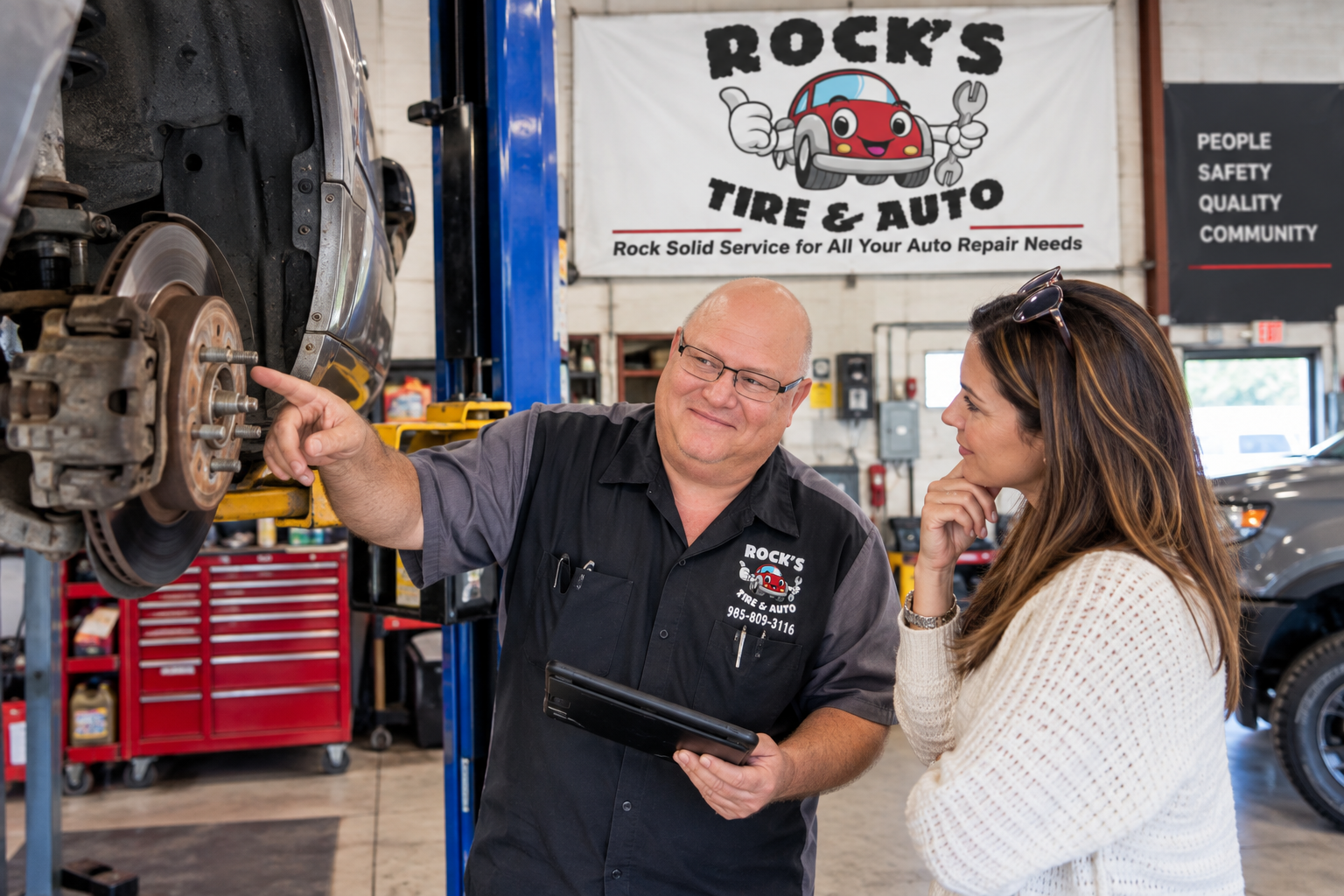
We start by listening to what you’ve noticed. If the vehicle is safe to drive and the noise occurs on the road, a technician may take it out under similar conditions. For a braking concern, we might inspect the pads, rotors, and hardware. For a hum, we may check tread wear and wheel bearings. For a rattle over bumps, we look for loose parts and check how the relevant steering and suspension components move.
When a picture or video can show what we found, we can include it in your Vehicle Wellness Check. A photo can help you see a torn CV boot or uneven tire wear. A video can show movement in a component that’s difficult to describe over the phone. For a sound that needs more testing, we’ll explain what we’ve found so far and what we’d check next.
If you’re hearing a new noise around Covington or elsewhere in St. Tammany Parish, give Rock’s Tire & Auto a call or schedule online. Tell us what you hear and when it happens. We’ll help you figure out the next step and explain which findings need attention first.
Frequently asked questions about car noises
Is it safe to drive when my car starts making noise?
It depends on the sound and what else is happening. A brief squeak after rain with normal braking feels different from grinding accompanied by a soft brake pedal. Pull over safely and arrange help for reduced braking or steering control, sudden severe shaking, smoke or steam, a flashing check engine light, a low oil pressure warning, or a sudden heavy engine knock. If you’re unsure about a new noise, call the shop from a safe place and describe what you noticed.
Why does my car squeak only first thing in the morning?
Timing and pedal use help narrow it down. If it squeaks only when you first apply the brakes, overnight moisture or light surface rust may be involved. If it squeals as soon as you start the engine while still parked, we’ll consider the accessory belt and related components. A noise that lasts longer each morning, happens in dry weather too, or returns throughout the day is worth checking.
How can I tell if a humming noise is my tires or a wheel bearing?
Notice how it responds to different pavement and to ordinary curves. A noise that changes with the road surface often points toward the tires. A hum or roar that builds with speed and changes as the vehicle goes through a gentle curve may point toward a bearing. Both can sound similar from inside the cabin. A tire and bearing inspection can help confirm the source.
Why does my car click when I turn?
Repeated clicking while turning slowly under light acceleration can come from an outer CV joint. A single pop or click while turning the steering wheel in place gives us a different set of clues involving the steering, suspension, or nearby components. Mention whether the vehicle has to be moving and whether you hear it turning left, right, or both.
Can a check engine light scan tell me what’s making the noise?
A scan can retrieve trouble codes that help guide testing when the vehicle’s computer detects a fault. A wheel bearing, a loose heat shield, or a worn suspension link may make plenty of noise without setting a code. When a code is present, we use it alongside your description and inspection findings to narrow down what’s happening.
What if the shop can’t hear the noise when I bring it in?
Tell us the conditions that make it most likely to happen. If you only hear it on the first cold start, we may need to check it after the vehicle has sat long enough to cool. If it happens on one particular stretch of road, tell us what’s different about that stretch. A recording and a few notes about speed, temperature, and what you were doing can help us plan the next check.
Why did the noise start right after I hit a pothole?
The impact can damage a tire or wheel, and it may affect suspension or steering components. A new scrape, thump, pull, or vibration after an impact is worth taking seriously. If the vehicle shakes severely, pulls hard, or has a visibly damaged tire, pull over safely and get assistance. Tell the shop which wheel took the hit if you know.
Should I wait until my next oil change to mention a new noise?
Mention it when you notice it, especially if it’s getting louder, happening more often, or showing up when braking or steering. When you call, give us the sound, what brings it on, and anything else that changed. That helps us advise you on how soon the vehicle should be seen and whether it makes sense to combine the inspection with your next service.